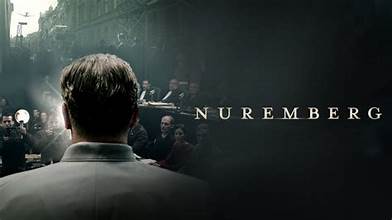
What “Nuremberg” teaches about guilt, evil, and the pursuit of world justice: the law has its limits

With his most recent drama shedding new light on how the Allies chose justice over retaliation in the tumultuous wake of Nazi Germany’s surrender, Russell Crowe is taking center stage in a fresh analysis of the Nuremberg trials. We have all the horrifying details revealing the reality behind the film.
The Allied powers, still grieving from nearly 30 million combat casualties and the destruction of Europe, set up an unusual trial in the Bavarian city of Nuremberg six months after Germany submitted in May 1945 to bring charges against Adolf Hitler’s senior surviving officers. The events that transpired when psychiatrist Douglas Kelley, played by 44-year-old Malek, evaluated Hitler’s deputy Hermann Goering, played by 61-year-old Crowe, are revisited in the film Nuremberg, starring Oscar winners Crowe and Rami Malek. Beginning on November 20, 1945, the nearly year-long proceedings forced the public to confront the newly defined crime of genocide, exposed the world to photographs of extermination camps, and established the allegation of crimes against humanity.
British judge Sir Geoffrey Lawrence, whose grandson Patrick Lawrence, KC, has now recalled the political conflicts that defined the tribunal, presided over the cases.
He stated: “Churchill had originally suggested simply putting them up against a wall and shooting them.”
Heinrich Himmler committed suicide while in British prison, while Hitler and his successor Joseph Goebbels had committed suicide in Berlin. Josef Mengele was among those who managed to flee. However, Goering, Rudolf Hess, and Joachim von Ribbentrop were taken prisoner, and the Allies argued over the extent of accountability. At first, military commander Wilhelm Keitel and naval chief Karl Donitz were viewed as peripheral, with some British officials pointing out that they were merely carrying out orders. However, they were among the defendants because of their power over such instructions.
It was difficult for prosecutors to define atrocities that had never been codified. “We didn’t even have the term genocide until just before the trial began,” Lawrence continued. It was brought up in a court case for the first time.
Because the offenses the defendants were accused of were not listed in any statute book, my grandfather was aware that the entire business was legally dubious. They were created after the fact. He was aware of the issue, but something had to happen to them.
Despite pressure from Moscow, where Soviet authorities anticipated death sentences, Lawrence’s grandpa insisted on procedural justice. Defendants often made fun of the proceedings at the same time. Goering chuckled as camp footage was shown, and Hess pretended to have amnesia. When British prosecutor Sir David Maxwell-Fyfe meticulously uncovered evidence demonstrating Goering’s knowledge of the unlawful executions of Allied captives, it marked a significant turning point. The film captured by Allied military photographers during the liberation of the Nazi extermination camps was exhibited to the court. It showed the hungry bodies of survivors, the inside of gas chambers, and towering stacks of skeletons. There were also reports of prisoners of war being slain by being pushed off 100-foot cliffs or made to stand naked for two days in bitter cold.
“Maxwell-Fyfe cross-examined Goering in a very sort of plodding English way on the documents just to prove that Goering had known about the order to murder escaped prisoners of war,” stated Lawrence.
Out of the 24 accused, all but three were ultimately found guilty. Goering received a hanging sentence.
However, he took a cyanide pill to terminate his life as a final act of defiance against the Allies.
“I think people eventually realized that it was done as fairly as possible within the constraints of this extraordinary process,” Lawrence stated. I worry that the virtue of trying to treat your adversaries fairly may be fading, but it’s a crucial one, and the trial helped establish that idea.” Among the 24 individuals who were ultimately charged were Wilhelm Keitel, Alfred Rosenberg, and Hermann Göring, leaders of the Nazi party. The Gestapo and the SS were among the six groups that were charged.
“I think, at a certain point, he managed to convince himself that if his performance in court was strong enough, he might get away with it all,” Crowe stated.
The success of the Nuremberg trials and the extraordinary level of international collaboration they demanded are largely responsible for the public’s comprehension of these concepts. However, the limitations of the law in holding the worst of the worst accountable are demonstrated by the precarious state of international justice today as well as the continued complexity of legal and moral concepts of guilt. Officials from the United States, the United Kingdom, and the Soviet Union had already started debating the best ways to deal with a defeated Germany some years before to the end of World War II. U.S. Secretary of War Henry L. Stimson was among the leaders who advocated for trials that closely followed American judicial norms. Others disagreed, citing the Leipzig trials’ failure, such as British Foreign Secretary Anthony Eden. The majority of the accused were already under arrest when the four senior prosecutors of the International Military Tribunal—representing the United Kingdom, the United States, the Soviet Union, and France—filed the indictment for the Nuremberg trials. In order to strengthen their cases, the prosecuting attorneys also had access to a wealth of Nazi documentation. Crimes against humanity and crimes against peace had not yet been defined, but the category of war crimes was based on existing international accords.
The hearings of the International Military Tribunal took place from November 20, 1945, until September 1, 1946. The case was presided over by four judges, one from each of the nations that convened the tribunal. A chief prosecutor was also chosen by each of the four participating nations to oversee the prosecution. Subject to the court’s approval, defendants could choose their own attorneys.
Following a month of deliberation, the judges rendered their final decisions on October 1, 1946. Twelve of the 22 individual defendants received death sentences after 19 of them were found guilty.
Not the initial effort to achieve international justice
The prosecution of war crimes in an international court did not begin with these trials.
In order to prosecute Germans charged with war crimes during World War I, the Leipzig war crimes trials were held in 1921. However, logistical and procedural problems, such as the challenge of bringing the accused to court, hindered these trials.